
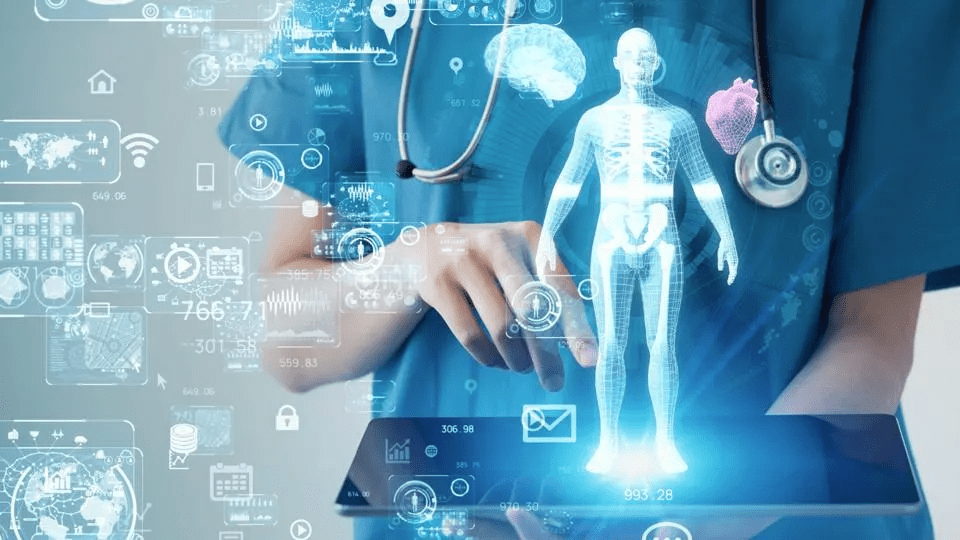
Artificial Intelligence (AI) in healthcare is revolutionizing the way medical professionals deliver care, diagnose diseases, and make treatment decisions. This article provides an in-depth exploration of what AI in healthcare entails, delving into the technologies that power it and showcasing various applications that are transforming the medical landscape.
I. What is AI in Healthcare?
1.1 Defining AI in Healthcare
Benefits of AI in healthcare encompasses application of artificial intelligence technologies to analyze complex medical data, interpret patterns, and make informed decisions to improve patient outcomes. This involves the use of algorithms, machine learning, natural language processing, and computer vision to augment and enhance various aspects of healthcare delivery.
1.2 Key Components of AI in Healthcare
1.2.1 Machine Learning (ML)
Machine learning is a subset of AI that enables systems to learn and make predictions or decisions without explicit programming. In healthcare, ML algorithms can analyze vast datasets to recognize patterns, identify anomalies, and make accurate predictions, particularly in diagnostics and treatment planning.
1.2.2 Natural Language Processing (NLP)
Natural Language Processing focuses on the interaction between computers and human language. In healthcare, NLP is used to extract meaningful insights from unstructured medical data, such as clinical notes, research articles, and patient records. This facilitates better understanding and utilization of textual information.
1.2.3 Computer Vision
Computer vision enables machines to interpret and understand visual information. In healthcare, computer vision is applied to medical imaging, allowing for the analysis of radiological images, pathology slides, and other visual data to aid in disease diagnosis and treatment.
1.2.4 Predictive Analytics
Predictive analytics involves the use of statistical algorithms and machine learning to analyze historical data and predict future trends. In healthcare, predictive analytics can assist in forecasting disease outbreaks, identifying at-risk patient populations, and optimizing resource allocation.
II. Technologies Used in AI for Healthcare
2.1 Machine Learning
2.1.1 Supervised Learning
In supervised learning, algorithms are trained on labeled datasets, where the input data is paired with the corresponding desired output. This approach is commonly used in healthcare for tasks such as image classification, where algorithms learn to identify patterns by being exposed to a labeled dataset of medical images.
2.1.2 Unsupervised Learning
Unsupervised learning involves training algorithms on unlabeled datasets, allowing them to identify patterns and relationships within the data. In healthcare, unsupervised learning can be applied to cluster patients based on similar characteristics, aiding in personalized medicine and patient stratification.
2.1.3 Reinforcement Learning
Reinforcement learning involves training algorithms to make decisions through trial and error, receiving feedback in the form of rewards or penalties. In healthcare, reinforcement learning can be used for treatment optimization and personalized therapy planning.
2.2 Natural Language Processing (NLP)
2.2.1 Named Entity Recognition (NER)
NER in healthcare NLP involves identifying and classifying entities within text, such as extracting information about diseases, medications, and procedures from clinical notes. This aids in information retrieval and analysis.
2.2.2 Sentiment Analysis
Sentiment analysis in healthcare NLP focuses on understanding the emotions and opinions expressed in textual data. This can be applied to patient feedback, social media discussions, and healthcare provider communications to gauge sentiments and improve patient satisfaction.
2.2.3 Text Summarization
Text summarization algorithms condense large volumes of medical text into concise and informative summaries. This is particularly useful for summarizing research articles, patient records, and clinical notes, facilitating efficient information review by healthcare professionals.
2.3 Computer Vision
2.3.1 Image Classification
In healthcare, computer vision is extensively used for image classification tasks, such as identifying and categorizing abnormalities in medical images. This includes the detection of tumors in radiological scans and the classification of skin lesions for dermatological diagnoses.
2.3.2 Object Detection
Object detection algorithms in healthcare enable the identification and localization of specific objects within images. This can be applied to detect anatomical structures or abnormalities in medical images, assisting radiologists and pathologists in their diagnoses.
2.3.3 Image Segmentation
Image segmentation involves dividing medical images into meaningful regions, aiding in the detailed analysis of specific structures or anomalies. This is crucial in applications such as organ segmentation for surgical planning or delineating tumor boundaries for precise treatment.
2.4 Predictive Analytics
2.4.1 Time Series Analysis
Time series analysis in healthcare predictive analytics involves studying data collected over time to identify patterns, trends, and potential future outcomes. This is valuable in predicting disease progression, patient deterioration, and optimizing treatment schedules.
2.4.2 Risk Stratification
Predictive analytics is used to stratify patient populations based on their risk of developing certain conditions or experiencing specific events. This aids in preventive care, allowing healthcare providers to proactively intervene with high-risk individuals.
2.4.3 Resource Optimization
Predictive analytics helps healthcare institutions optimize resource allocation by forecasting patient admissions, bed utilization, and equipment requirements. This ensures efficient use of resources and improves overall healthcare management.
III. Applications of AI in Healthcare
3.1 Disease Diagnosis and Prediction
3.1.1 Radiology Imaging
AI applications in radiology use machine learning and computer vision to analyze medical images, assisting in the early detection and accurate diagnosis of various diseases, including cancers, fractures, and neurological disorders.
3.1.2 Predictive Diagnostics
Predictive analytics in diagnostics leverages patient data to predict the likelihood of developing certain conditions. For example, AI models can assess genetic and lifestyle factors to predict the risk of cardiovascular diseases or diabetes.
3.1.3 Pathology Analysis
Computer vision aids pathologists in analyzing pathology slides. AI algorithms can identify and classify cells, helping diagnose diseases such as cancer with increased accuracy and efficiency.
3.2 Personalized Medicine
3.2.1 Genetic Analysis
AI in genetics analyzes genomic data to identify genetic variations and their implications on an individual’s health. This information is used to tailor treatment plans, predict responses to medications, and inform personalized therapeutic interventions.
3.2.2 Treatment Optimization
Machine learning algorithms analyze patient data, including treatment responses and adverse reactions, to optimize and personalize treatment plans. This ensures that patients receive interventions that are most likely to be effective for their specific conditions.
3.2.3 Precision Oncology
Precision oncology utilizes AI to analyze genetic and molecular data from cancer patients. This information helps oncologists identify targeted therapies that are tailored to the specific genetic makeup of a patient’s tumor.
3.3 Virtual Health Assistants
3.3.1 Chatbots and Virtual Nurses
Chatbots and virtual nurses powered by AI engage with patients to provide information, answer queries, and offer support. These virtual health assistants enhance patient education, adherence to treatment plans, and overall healthcare communication.
3.3.2 Medication Management
AI-driven virtual assistants assist patients in managing their medications. This includes medication reminders, dosage instructions, and monitoring for potential drug interactions, improving medication adherence and patient safety.
3.3.3 Remote Monitoring
AI enables remote monitoring of patients with chronic conditions. Wearable devices and sensors collect real-time health data, allowing healthcare providers to intervene proactively and adjust treatment plans based on continuous monitoring.
3.4 Drug Discovery and Development
3.4.1 Target Identification
AI accelerates drug discovery by identifying potential drug targets through the analysis of biological data. This includes the exploration of genetic, protein, and metabolic information to pinpoint vulnerabilities that can be targeted with new medications.
3.4.2 Compound Screening
Machine learning models screen vast chemical compound libraries to identify potential drug candidates. This speeds up the early stages of drug development, reducing the time and costs associated with finding viable compounds.
3.4.3 Clinical Trial Optimization
Predictive analytics in drug development optimizes clinical trial designs by identifying suitable patient populations, predicting patient recruitment rates, and forecasting trial outcomes. This ensures more efficient and cost-effective clinical trials.
3.5 Predictive Analytics for Patient Management
3.5.1 Early Warning Systems
Predictive analytics powers early warning systems that identify patients at risk of deterioration. This enables healthcare providers to intervene early, preventing adverse events and improving patient outcomes.
3.5.2 Chronic Disease Management
Predictive analytics aids in the management of chronic diseases by predicting exacerbations and complications. This allows healthcare providers to tailor interventions for better disease control and improved quality of life for patients.
3.5.3 Hospital Resource Planning
Healthcare institutions use predictive analytics to plan and allocate resources efficiently. This includes forecasting patient admissions, optimizing bed utilization, and ensuring adequate staffing levels for different departments.
3.6 Robotic Surgery
3.6.1 Surgical Planning
AI assists in surgical planning by analyzing medical images to create detailed 3D models of anatomical structures. Surgeons can use these models for preoperative visualization and to plan the most optimal surgical approach.
3.6.2 Intraoperative Assistance
During surgery, AI-powered robotic systems provide real-time assistance to surgeons. This includes precision control, enhanced visualization, and the ability to perform complex tasks with increased accuracy.
3.6.3 Postoperative Recovery
AI contributes to postoperative care by monitoring patients and providing data-driven insights into their recovery. This aids in identifying potential complications early and ensuring optimal postoperative outcomes.
IV. Conclusion
Artificial Intelligence in healthcare is a transformative force that is reshaping the industry, offering solutions to longstanding challenges and improving patient care. The integration of machine learning, natural language processing, computer vision, and predictive analytics is paving the way for more personalized, efficient, and effective healthcare delivery.
As technologies continue to advance, the applications of AI in healthcare will expand, leading to further innovations in diagnostics, treatment planning, and patient management. The collaboration between healthcare professionals and AI systems holds the potential to revolutionize medical practices, offering a future where healthcare is not only more accurate and proactive but also more patient-centered and accessible. Embracing these technologies responsibly and addressing ethical considerations will be crucial as AI continues to play an increasingly integral role in the healthcare ecosystem.
 TechnoAI
Leave a comment