
In the ever-evolving landscape of healthcare, the integration of Generative Artificial Intelligence (AI) is poised to redefine the future of medicine. The ability of generative AI to create new and valuable content, coupled with advancements in machine learning and data analytics, holds the potential to revolutionize diagnostics, drug discovery, and personalized medicine. In this article, we explore the promising avenues and potential transformations that the future of generative AI in healthcare may bring.
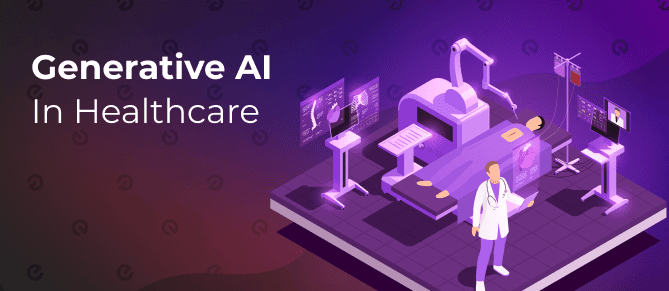
Future of Generative AI in healthcare examples are discussed in detail below:
1. Enhancing Diagnostics and Imaging
The future of generative AI in healthcare is expected to bring about significant advancements in diagnostics and medical imaging. Currently, generative AI techniques, such as Generative Adversarial Networks (GANs) and Variational Autoencoders (VAEs), are already proving invaluable in generating synthetic medical images and assisting in diagnostic processes.
1.1 Radiology and Pathology Assistance
Generative AI is anticipated to play a more prominent role in assisting radiologists and pathologists by providing real-time insights into medical images and pathology slides. The ability of generative AI to generate high-quality synthetic images for training purposes is expected to enhance the accuracy of diagnostic models. This, in turn, could lead to earlier and more precise detection of diseases.
1.2 3D Imaging and Virtual Reality
The future sees the integration of generative AI with 3D imaging technologies and virtual reality (VR). This combination could revolutionize the visualization of complex medical data, allowing healthcare professionals to navigate through three-dimensional representations of patient anatomy. This immersive approach has the potential to improve pre-surgical planning and enhance medical education.
2. Accelerating Drug Discovery
Drug discovery, a traditionally time-consuming and expensive process, stands to benefit significantly from the continued evolution of generative AI. The future landscape of drug development is likely to witness accelerated timelines, cost efficiencies, and the discovery of novel therapeutic candidates.
2.1 Virtual Screening and Molecular Design
Generative AI models, particularly those based on GANs and reinforcement learning techniques, are anticipated to become integral in virtual screening for potential drug candidates. These models can analyze vast chemical spaces, predict molecular interactions, and suggest compounds with high therapeutic potential. This could lead to the identification of new drugs more efficiently than traditional methods.
2.2 Personalized Medicine and Drug Targeting
As generative AI continues to advance, personalized medicine will become more prevalent. AI algorithms will analyze patient-specific data, including genetic information, to predict individual responses to medications. This tailored approach ensures that patients receive treatments optimized for their unique biological characteristics, maximizing efficacy and minimizing side effects.
3. Shaping the Landscape of Personalized Medicine
The future of generative AI in healthcare is intricately linked with the evolution of personalized medicine. The ability to analyze vast datasets, including genomics, proteomics, and electronic health records, enables the development of tailored and patient-specific treatment plans.
3.1 Predictive Analytics for Disease Prevention
Generative AI models, when applied to large datasets, can predict disease trends and identify individuals at higher risk of developing specific conditions. This proactive approach to healthcare allows for preventive interventions, lifestyle modifications, and early detection strategies, ultimately reducing the burden of disease.
3.2 Patient-Specific Treatment Plans
With the integration of generative AI, healthcare professionals can develop treatment plans that are highly individualized. These plans consider not only the patient’s medical history and genetic makeup but also their lifestyle and environmental factors. This holistic approach to healthcare ensures that interventions are tailored to address the unique needs of each patient.
4. Ethical Considerations and Responsible AI Use
As the future of generative AI unfolds in healthcare, ethical considerations and responsible AI use become increasingly critical. Addressing issues related to bias, data privacy, and transparency is paramount to ensuring the trustworthiness and acceptance of generative AI applications.
4.1 Mitigating Bias in Healthcare Algorithms
Generative AI models, like any other AI systems, are susceptible to biases present in training data. Future developments will focus on implementing techniques to identify and mitigate biases, ensuring that AI applications provide fair and unbiased insights across diverse patient populations.
4.2 Transparent and Explainable AI Models
To build trust among healthcare professionals and patients, future generative AI models will prioritize transparency and explainability. Understanding how AI arrives at specific conclusions is crucial for the ethical deployment of these technologies, particularly in critical decision-making processes.
5. Collaborative Healthcare Ecosystems and Interconnected Technologies
The future of generative AI in healthcare envisions a collaborative ecosystem where AI seamlessly integrates with other emerging technologies, fostering interconnected and intelligent healthcare solutions.
5.1 Integration with Internet of Things (IoT) Devices
Generative AI will likely be integrated with IoT devices for real-time data collection and monitoring. Wearable devices, sensors, and connected medical devices will contribute to the generation of continuous streams of data, allowing AI algorithms to provide timely insights and personalized recommendations.
5.2 Edge Computing for Real-Time Decision-Making
Edge computing, which involves processing data closer to the source rather than relying on centralized cloud servers, will play a crucial role in the future of generative AI in healthcare. Real-time decision-making at the edge enables faster responses to critical situations, particularly in scenarios where immediate intervention is necessary.
6. Addressing Healthcare Disparities and Global Access
Generative AI has the potential to address healthcare disparities and improve global access to medical expertise. As the technology evolves, efforts will be made to ensure that generative AI applications are accessible and beneficial to diverse populations worldwide.
6.1 Telemedicine and Remote Healthcare
Generative AI will play a pivotal role in the expansion of telemedicine and remote healthcare. Virtual consultations, AI-driven diagnostics, and remote patient monitoring will become more sophisticated, providing healthcare access to individuals in remote or underserved areas.
6.2 Low-Resource Settings and Global Health Initiatives
Efforts to make generative AI accessible in low-resource settings and support global health initiatives will be a key focus. The adaptation of AI models for resource-constrained environments can contribute to more equitable healthcare outcomes on a global scale.
7. Continued Advancements in Natural Language Processing (NLP)
The future of generative AI in healthcare will witness ongoing advancements in Natural Language Processing (NLP). This technology enables machines to understand, interpret, and generate human-like text, facilitating communication between AI systems and healthcare professionals.
7.1 Improved Clinical Documentation and Information Extraction
Generative AI, equipped with advanced NLP capabilities, will aid in improving clinical documentation processes. The automatic extraction of relevant information from medical records and the generation of structured and comprehensive reports will enhance the efficiency of healthcare workflows.
7.2 Conversational AI for Patient Interaction
Conversational AI, powered by generative models, will play a crucial role in patient interactions. Virtual assistants and chatbots will become more sophisticated in understanding and responding to natural language queries, providing information, scheduling appointments, and offering support to patients.
8. Ethical and Regulatory Frameworks for Responsible AI Use
As the future unfolds, the establishment of comprehensive ethical and regulatory frameworks will be essential to guide the responsible development and deployment of generative AI in healthcare.
8.1 Ethical Guidelines for AI in Medicine
Healthcare organizations and regulatory bodies will work collaboratively to develop ethical guidelines specific to the use of AI in medicine. These guidelines will address issues such as informed consent, transparency, and the responsible handling of patient data.
8.2 Regulatory Approval Processes for AI Applications
Regulatory agencies will refine and establish approval processes for AI applications in healthcare. This includes ensuring that AI-driven diagnostic tools meet rigorous standards for accuracy, safety, and reliability before they are deployed for clinical use.
Conclusion: Shaping the Healthcare Landscape of Tomorrow
The future of generative AI in healthcare holds immense promise, poised to shape the landscape of medicine and patient care in unprecedented ways. From revolutionizing diagnostics and drug discovery to advancing personalized medicine and addressing global healthcare disparities, the potential impact of generative AI is profound.
However, as we embrace this transformative journey, it is crucial to navigate ethical considerations, regulatory challenges, and ensure the responsible use of AI technologies. The collaborative efforts of healthcare professionals, researchers, technologists, and regulatory bodies will be instrumental in realizing the full potential of generative AI while prioritizing patient safety, privacy, and equitable access to healthcare innovations.
As we look ahead, the fusion of generative AI with emerging technologies, the refinement of ethical frameworks, and the establishment of regulatory standards will collectively contribute to a healthcare ecosystem that is more intelligent, accessible, and responsive to the diverse needs of individuals and communities worldwide. The future of generative AI in healthcare is not just a technological evolution; it represents a paradigm shift that holds the promise of transforming the practice of medicine and improving the well-being of people around the globe.
 TechnoAI
Leave a comment