
Introduction
The integration of artificial intelligence (AI) into production planning and scheduling has already proven to be a game-changer in the manufacturing landscape. As technology continues to advance, it’s crucial to explore the future trends that will further enhance the role of AI in optimizing production processes.
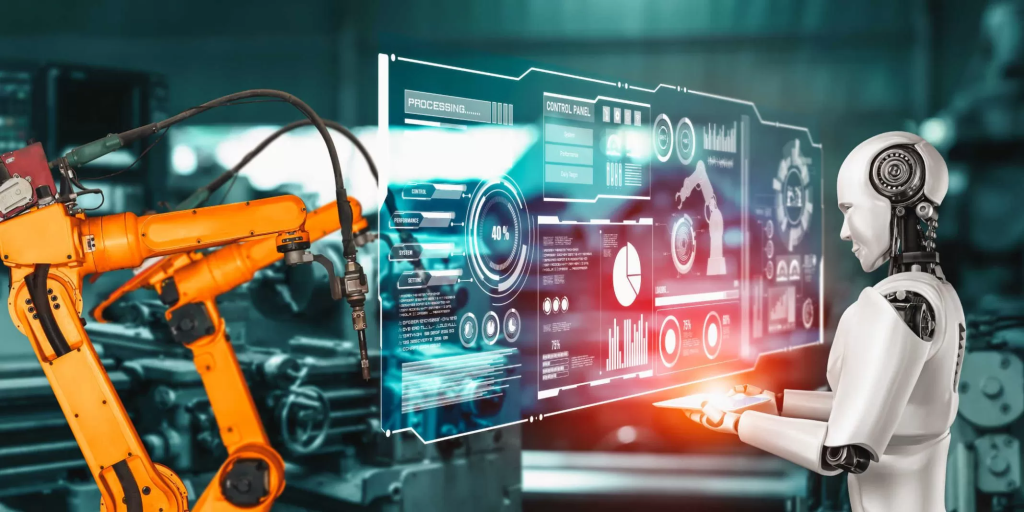
This article delves into the upcoming trends in AI-powered production planning and scheduling, providing insights into how these technologies will shape the future of manufacturing.
1. AI-Powered Demand Sensing
1.1 The Current Landscape
Traditionally, demand forecasting has been based on historical data, market trends, and statistical models. While effective, it may not capture sudden shifts or emerging trends in real-time, leaving manufacturers vulnerable to unexpected changes in consumer behavior.
1.2 Future Trend
AI-powered demand sensing is set to revolutionize how manufacturers anticipate and respond to market shifts. By leveraging machine learning algorithms, AI will continuously analyze real-time data, including social media trends, economic indicators, and global events. This will enable more accurate and timely demand forecasts, allowing manufacturers to adapt production plans swiftly in response to dynamic market conditions.
2. Integration of AI and IoT for Real-Time Data Insights
2.1 The Current Landscape
AI has significantly improved production planning by providing data-driven insights. However, the full potential of AI in production planning can be unlocked by combining it with real-time data from the Internet of Things (IoT) devices.
2.2 Future Trend
The integration of AI and IoT will become more seamless, providing manufacturers with a comprehensive and real-time view of their production processes. IoT devices, such as sensors on machinery and equipment, will continuously feed data to AI algorithms. This convergence will enhance decision-making accuracy, enable predictive maintenance, and further optimize production scheduling based on the most up-to-date information available.
3. Exponential Growth of Predictive Analytics
3.1 The Current Landscape
Predictive analytics is already a cornerstone of AI in production planning, offering manufacturers the ability to foresee potential issues and optimize processes. However, the future holds the promise of even more sophisticated predictive capabilities.
3.2 Future Trend
The use of predictive analytics will see exponential growth, fueled by advancements in machine learning algorithms and increased availability of big data. Manufacturers will rely on AI to not only predict demand but also anticipate machine failures, supply chain disruptions, and other potential bottlenecks. This proactive approach will minimize risks and enhance overall production efficiency.
4. AI-Driven Autonomous Decision-Making
4.1 The Current Landscape
AI currently assists human decision-makers by providing data-driven insights and recommendations. However, the future envisions a shift towards more autonomous decision-making processes.
4.2 Future Trend
AI algorithms will evolve to make more complex decisions autonomously. With the integration of reinforcement learning and advanced cognitive computing, AI systems will not only provide recommendations but also execute decisions in real-time. This autonomous decision-making will streamline production planning and scheduling, reducing the need for constant human intervention.
5. Enhanced Human-Machine Collaboration
5.1 The Current Landscape
The use of AI in production planning has sometimes raised concerns about job displacement and a potential disconnect between human decision-makers and AI systems.
5.2 Future Trend
The future will see an emphasis on enhancing collaboration between humans and AI. AI systems will become more intuitive and user-friendly, allowing non-technical users to interact seamlessly with these technologies. This collaborative approach will empower human decision-makers, leveraging AI as a valuable tool to augment their capabilities rather than replace them.
6. AI for Sustainable Production Practices
6.1 The Current Landscape
Sustainability is a growing concern in manufacturing, with a focus on reducing waste, energy consumption, and environmental impact. AI is already contributing to more efficient resource utilization, but the future holds even more potential for sustainable practices.
6.2 Future Trend
AI will play a pivotal role in optimizing production processes for sustainability. Machine learning algorithms will assess the environmental impact of different production scenarios, recommending and implementing changes to reduce carbon footprints. From energy-efficient scheduling to waste reduction strategies, AI will contribute significantly to making manufacturing practices more sustainable.
7. Edge Computing for Real-Time Decision-Making
7.1 The Current Landscape
While cloud computing has been instrumental in processing large datasets, real-time decision-making may be limited by latency in transmitting data between devices and the cloud.
7.2 Future Trend
Edge computing, where data is processed closer to the source (on the “edge” of the network), will become more prevalent. This trend is particularly significant for AI in production planning, as it allows for quicker analysis of real-time data. The reduced latency enables faster decision-making, making production processes even more responsive and agile.
8. AI-Enhanced Cybersecurity Measures
8.1 The Current Landscape
As AI becomes more integral to production planning, ensuring the security of sensitive data and systems is paramount.
8.2 Future Trend
AI will be increasingly utilized to enhance cybersecurity measures in manufacturing. Advanced algorithms will continuously analyze data for potential security threats, detect anomalies, and respond in real-time to prevent cyber-attacks. This proactive approach will safeguard production planning systems from unauthorized access or malicious activities.
Conclusion
The future of AI-enhanced production planning and scheduling is poised for remarkable advancements. From AI-powered demand sensing to the integration of AI and IoT, predictive analytics, autonomous decision-making, enhanced human-machine collaboration, sustainable practices, edge computing, and cybersecurity measures – these trends collectively paint a picture of a manufacturing landscape that is more efficient, adaptive, and sustainable.
As manufacturers navigate the complexities of an ever-evolving market, embracing these future trends in AI for production planning will be key to maintaining a competitive edge. The synergy between human expertise and AI capabilities promises not just optimization of production processes but a transformative journey towards a more resilient and responsive manufacturing ecosystem.
 TechnoAI
Leave a comment